
Love the command line? Hate ugly, out-of-the-box formatting of your results? You’re in luck, we have just the thing for you: Oracle SQLcl. It offers the ability to auto-pretty up your SQL results to the screen. Here’s a quick video overview of what that is, and how it works. For those of you w/o access to YouTube How do you get through your day w/o cat videos and Marvel Studios movie trailers? Anyways, here’s a…
Password resets. It used to be a pain – it required installing and configuring an Oracle client. But, no more! Simply get version 4.2, and you’re good to go. Here’s the video. So go get version 4.2 already.
I don’t do enough video. I’ve been cheating with animated GIFs – they’re ‘nice’ because I don’t have to worry about the ‘ums’ and ‘ahs’ as I talk, or even about putting on a clean shirt. But, I have a bunch of videos I need to record for v4.2, so I thought I’d practice a bit. Here’s a short and sweet tutorial on how to go from a table to its index and back, and…
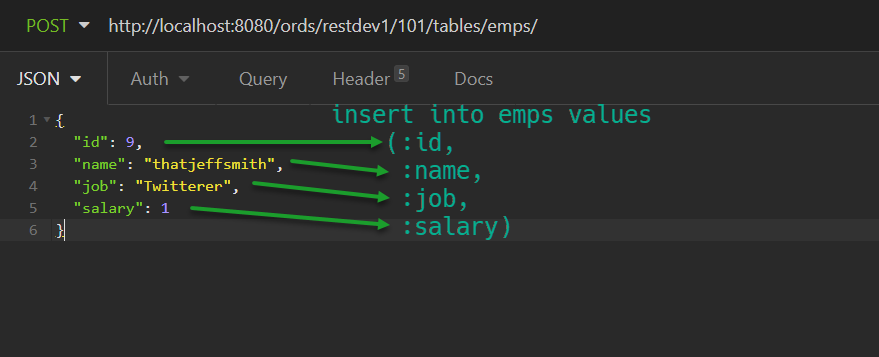
Can you? YES. Absolutely, even. Go from your app to your Oracle Database resources via REST (GET|POST|PUT|DELETE), and your responses come back via JSON. No APEX required. And even better, you can have ORDS up and running in less than 5 minutes. Ok, but what about ORDS & APEX? If you want to provide a RESTful API for your Oracle Database, then ORDS is for you. But, when I do talks on ORDS, I ask…
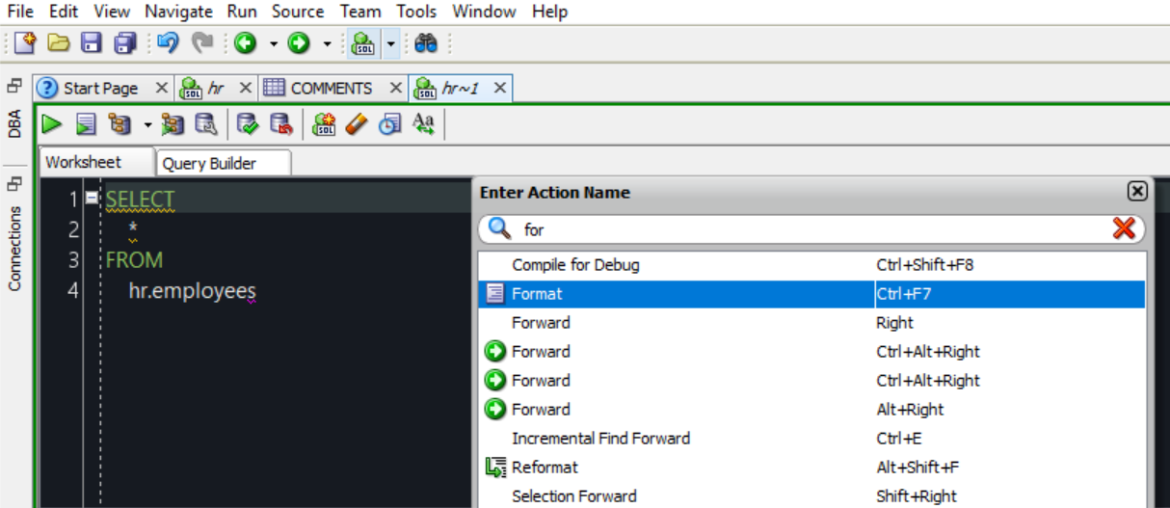
Just because you’re in a command line interface doesn’t mean you’re stuck with ugly code! Wait, if it’s my code, you’re stuck with ugly code. But if it’s YOUR code, then you’re not stuck with poorly formatted code. You can of course use the FORMAT command to format what’s in a file or in the SQLcl buffer. I don’t like the formatter default settings! Have no fear. Load up the GUI. Yes, THAT GUI. Set…
One of the major new features in Oracle Database 12c Release 2 is Analytic Views. An analytic view is a type of view that can be used to easily extend the content of a star schema with aggregated data, measure calculations and descriptive metadata, and to simplify the SQL needed to access data. Analytic views layer a hierarchical/dimensional model over data. Analytic views are defined over the dimension tables and fact table of a star…
Yesterday I talked about how to grab the output returned from your stored procedure when executing via Oracle REST Data Services. The example was: INSERT a new record into a table. Return the new employee ID and the total number of employees in the table. So we just needed 2 parameters for our handler to catch the two integers returned, easy-peasy. But, what if we were going to return the entire record? So let’s write…
Update: This post was refreshed on October 14, 2021. I have a very simple, and not very elegant stored procedure. 81497249869621c6b22d33_000008 Sidebar: Like, I’m not a professional developer. The WHEN OTHERS THEN bit…that’s BAD CODE, don’t do that. You should do something, more like THIS. This stored procedure takes in a name and salary. It inserts a record to my table, and returns the new employee’s ID and the new total number of employees in…
Want to get started on learning everything there is to know about the latest version of our Database? Don’t want to really have to install or create anything? Well, you’re in luck. Just go download our image. In a few minutes, you’ll be up and running with Database 12c Release 2. And APEX 5.1. And ORDS 3.0.9. And of course SQL Developer. Plus, you’ll get lots of Hands On Labs! Step by step instructions allow…
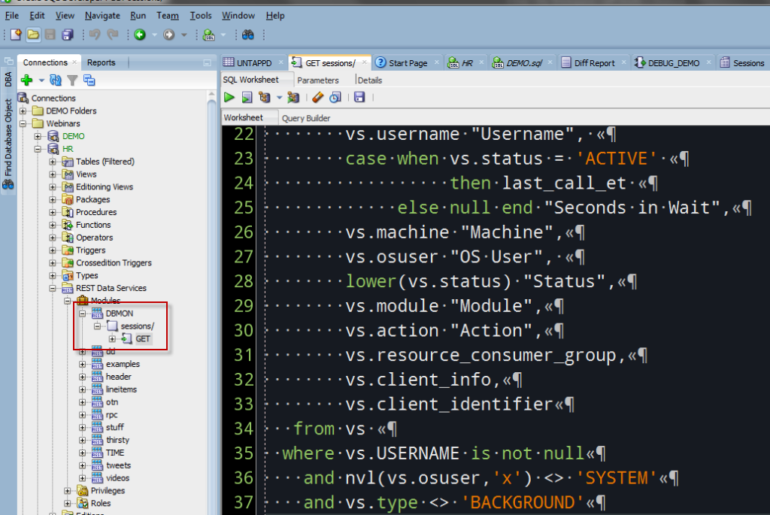
I have a RESTful Service that accepts a bind value to a query that ORDS will run for me. How do I pass that bind to ORDS? You can do it explicitly be defining it as part of the URI. Or, you can use the classic web ?var=value to pass it. ORDS supports both 🙂 The only difference is the URI itself. Easy, just include it on the call. So, which one to use? I…