

On February 14-16, I’ll be at the Colorado Convention Center in Denver, Colorado for RMOUG’s Training Days Conference. This is the largest regional Oracle User Conference in North America and attracts presenters from all around the country and the globe. I’ll be presenting: Presentation Name: SQL Developer Tips and Tricks for Developers Abstract: You use the GUI because you want to be productive, right? Do you ever get the feeling you’re only really using a…
It’s a relational database, so it’s only a matter of time before you stumble across an object that’s dependent on another object, right? If you are looking at a table in the browser, be sure to check out the ‘Dependencies’ page. This page displays the database objects that will be upset if the selected table were to ‘go away.’ You’re probably familiar with these related objects, but if not, then there’s a quick ‘trick’ to…
Data models sure are handy. They tell a story – how does the information get stored as data? Just what is a ‘customer?’ Sometimes though our applications die and only leave legacy scripts behind. Or maybe you are a DBA and someone has given you a set of scripts to create some new objects in your database. You ask them for their model, and they just look at you with that weird blank stare. “We…
Welcome to WordPress. This is your first post. Edit or delete it, then start blogging!
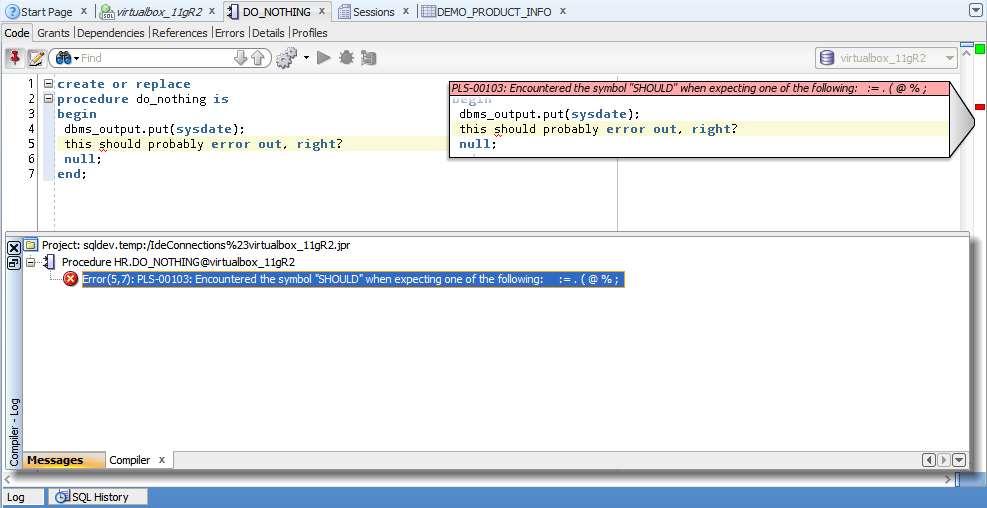
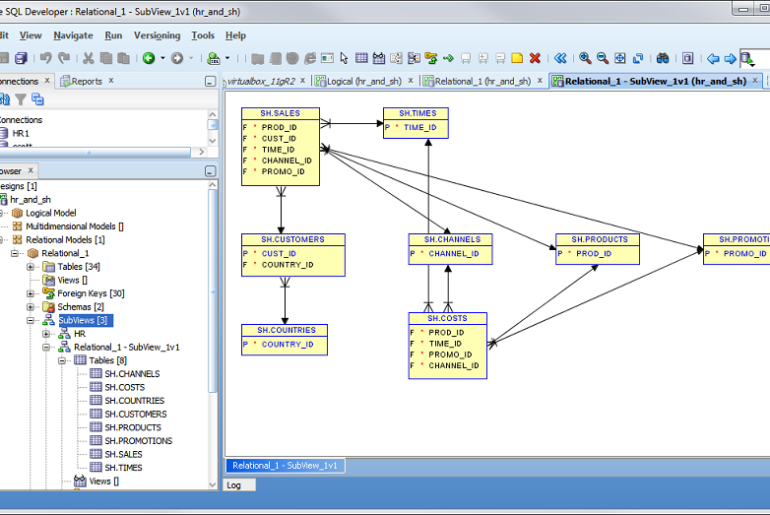
I’m going to go out on a limb and guess that most people who use SQL Developer do not realize it has a fully-baked data modeling tool built into it. It’s not like we hide it, but we kind of hide it. To open the Data Modeler inside of SQL Developer, navigate to the View menu, and activate the Data Modeler Browser, like so – Once opened, you’ll see a new ‘Browser’ panel beneath your…
New for version 3.1, currently available as a EA download, when defining the queries used to populate views, the modeler can generate JOINs using either Oracle’s or the standard ANSI compliant syntax. Let’s step back a second. When working with a VIEW defined in a relational model, the modeler has twp choices for defining the driving SQL statement that is used to populate the contents of the view. They can code it by hand -…
Binary Large Objects – otherwise known as BLOBs. You’ve also got large objects which are composed of text – that would be a CLOB. If you hear people talk about LOB storage, they are referring to how the data in these fields are stored – outside the space reserved for the regular segments (table data.) BLOBs are frequently used to store data such as pictures in the database. You can pretty much store anything in…
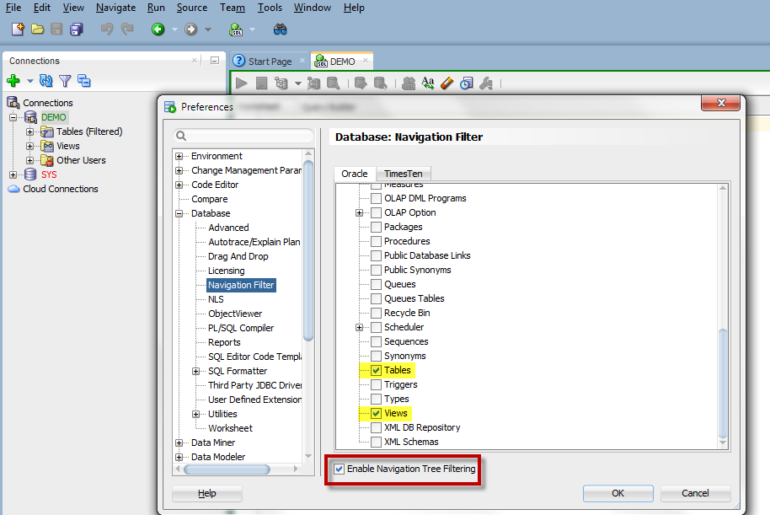
Updated June 2015, current for version 4.1 There are too many options in our every day lives. We love asking for more options, but I often find myself being overwhelmed by the number of questions I have to answer before I can accomplish very mundane tasks. Do you want your latte ‘skinny’ or your cappuccino ‘wet?’ Waffle House customers are probably familiar with ‘capped, covered, smothered, & covered’ routine. Do you want a receipt with…
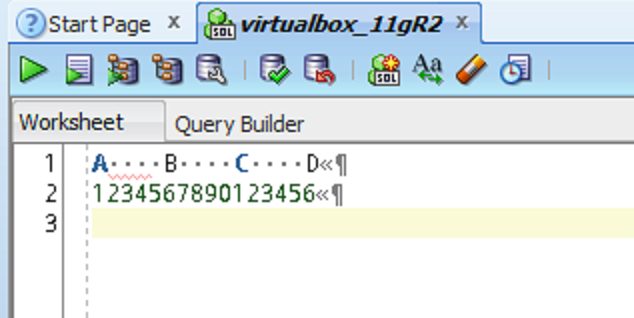
Update for version 4.2 and higher. As often happens, my ideas for blog posts are provided by end users asking for help. Sometimes I know the answer, sometimes I don’t. This is one of the latter cases. Chet AKA @oraclenerd asked me: ‘Tell me how to find the preference in sqldev to make a tab 2 spaces?’ I knew it had to be in there somewhere. This is a pretty basic setting for any word…
Image Left, Text Right It starts out OK, even fine really. Text here, should be up top and from the left, blah, blah, blah, blah, blah, blah, blah, blah, blah, blah, blah, blah, blah, blah, blah, blah, blah, blah, blah, blah, blah, blah, blah, blah, blah, blah, blah, blah, blah, blah, blah, blah, blah, blah, blah, blah, blah, blah, blah, blah, blah, blah, blah, blah, blah, blah, blah, blah, blah, blah, blah, blah, blah, blah,…