

Do you know someone who helps make our data safer, and more useful in the Oracle Database space? This could be an architect, engineer, data modeler – whatever, that works in the design area and shares their work and insight with the rest of the community. Someone who has something much more interesting to say than me: Please don't name your tables "FROM"— Jeff Smith (@thatjeffsmith) August 11, 2015 Oracle is hosting a Database Developer…
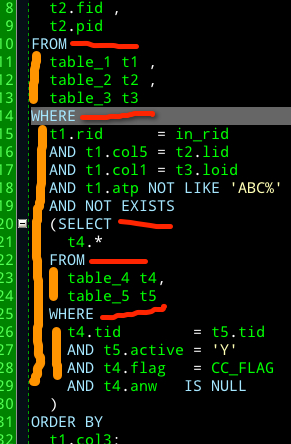
SQL can be hard to read. Execution plans can be EVEN HARDER to read. It doesn’t get any easier when you are joining a table to itself. Or maybe you are having a hard time finding the portion of a plan to correlates to a subquery. We do have a solution! QB_NAME Hint (Docs) /*+ QB_NAME ( qb_name ) */ So why am I talking about this today? Well one of our SQL Advocates, Connor…
Had a real fun time showing off a series of tips & tricks yesterday, and we did it all in 15 minutes! I can’t afford Mike Rowe or Morgan Freeman for voice over talent, so unfortunately this video has my voice. The things I show in this video, in blog form: SQL History Recall SQL Code Templates Joining multiple tables in a SELECT Query Builder Code Snippets Completion Insight SQL Text Expansion I hope my…
Do as I say, not as I do. Because I am like most of you, I am very lazy. Case in point: loading some data from a CSV into an Oracle table. I can use a wizard in SQL Developer and in a few clicks, have it loaded. Usually I’m playing with a hundred rows. Or maybe a few thousand. But this time I needed to load up about 150MB of CSV, which isn’t very…
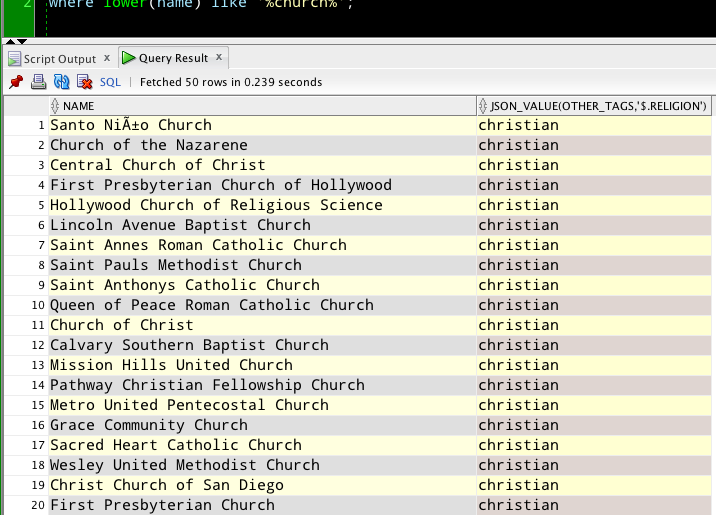
Working on some cool demos around JSON, ORDS, Oracle Database, JavaScript apps, etc. and I needed to load up a BUNCH of data to play with. Note the ‘other_tags’ column LOOKS like JavaScript Object Notation (JSON). There are JSON standards – should the key name and value strings be double or single quoted, etc. To ID text as JSON in Oracle it needs to pass our test. Also, you need Oracle 12c, specifically 12.1.0.2 (and…
How often do you need to build a new table to test something out? How often have you typed CREATE TABLE AS SELECT… If the answer to both of those question is ‘quite a bit Jeff!,’ then continue reading. In SQLcl, we have built a new command simply called ‘CTAS.’ So let’s try it out. What tables do I have to work with? I’m lazy, so instead of typing ‘select table_name from user_tables’ I just…
This is one of the features I showcased in a webcast yesterday – looking for a particular column definition in your relational model? We make that easy in SQL Developer. And, after you find all of these columns, you can quickly change them, all in one fell swoop. Ctrl+F in a model to open the search. Toggle to ‘Advanced.’ Set your search area and criteria. Hit the ‘Search’ button. Review the results, save as a…
This post will show how to connect to your Database as a Service environment running in our Oracle Cloud using Oracle SQL Developer. The screenshots below and demonstration steps are written with version 4.1.1 of SQL Developer. We (Oracle) basically have 2 types of Database services you can run in our cloud: Schema – known as Database Schema Service Database – known as Database as a Service (DBaaS) I’ll be talking about the DBaaS offering…
I’m at the beach! But if you desire fresh SQL Developer-themed content, then you are still in great shape. Check out these blogs: The Data Warrior AKA Oracle ACE Director Kent Graziano Heli from Finland AKA Oracle ACE Director and published author Heli Helskyaho Kris Rice Colm Divilly Barry McGillin Not Enough? I have a YouTube Channel with SQL Developer videos, because reading is boring. Moving pictures are so 1894. I have a SlideShare channel…
The team just got back from another Oracle User Group Conference, or I should say THE conference. I know most of you don’t get to go to conferences. Or have nice computers. Or use foreign keys. Or have nice things. BUT. One thing you do get to have today, is the same popular Oracle SQL Developer features demonstrated to you, right now. These are things that people ask me to demonstrate to them, the most.…